


Description
-
- Brand: FOXBORO
- Full Model Number: P0916PW / FBM217
- System/Series Family: Foxboro I/A Series 200 I/O
- Core Function: 32-channel discrete input interface for 24 VDC field signals using low-side sensing
- Top 3 Hardcore Specs: 32 DI channels; 24 VDC input; low-side sense
- Stock Status: Verify current New Surplus, Factory Sealed, or Fully Tested Refurbished condition before order
Module 3: Technical Product Introduction
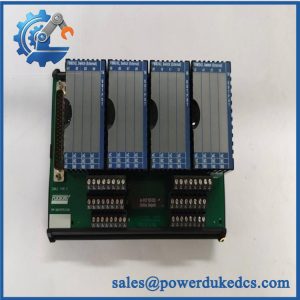
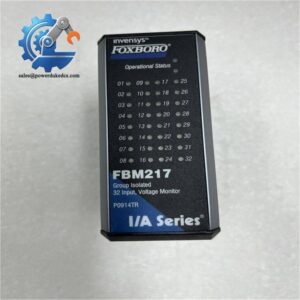
A failed discrete-input interface can remove dozens of field status points from a DCS at once. FOXBORO P0916PW, identified in Emerson’s FlexConnect documentation as FBM217/P0916PW, is a 32-channel discrete input interface for the Foxboro I/A Series 200 I/O family. Emerson’s documentation specifies the signal type as 32 DI, 24 VDC, low-side sense, and maps this exact FBM/P0916PW combination to the corresponding FlexConnect interface solution.
The main engineering point is the input topology. This is a dense discrete-input module, not a mixed analog/digital card, and its published application is centered on 24 VDC field-state acquisition. Current technical listings also identify P0916PW as the FBM217 interface, although some commercial descriptions disagree on channel count and voltage range; those conflicting listings should not override Emerson’s own FBM217/P0916PW signal definition. For replacement work, the installed terminal arrangement, field wiring, and exact FBM217 revision should therefore be checked before commissioning.
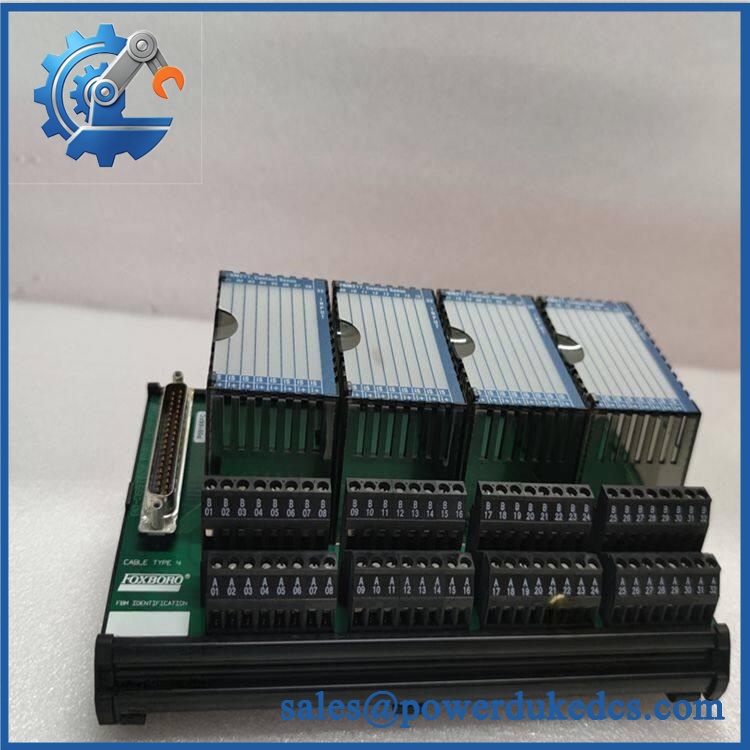
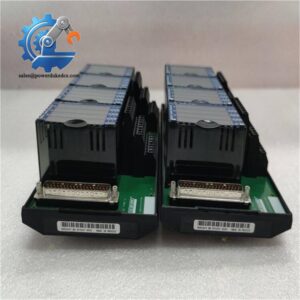
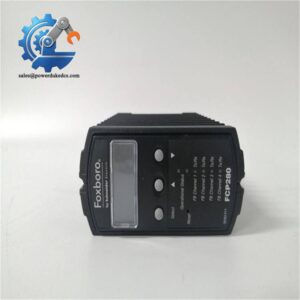
FOXBORO P0916PW FBM217
Module 4: Application Scenarios & Field Realities
- In a process DCS cabinet with dozens of discrete permissives, is suited to high-density acquisition of 24 VDC field states. Motor running feedback, valve-position switches, pump permissives, and alarm contacts can all consume discrete points quickly; 32 channels in one FBM reduces the number of separate interface locations. Emerson explicitly identifies FBM217/ as a 32-channel 24 VDC low-side-sense input type.
- For brownfield I/A Series 200 maintenance, channel topology matters more than the connector shape. A replacement that accepts 24 VDC but uses a different sensing arrangement can produce apparently plausible states while changing field-circuit behavior. Verify the original FBM number and wiring drawing before swapping the module.
- Where DeltaV migration is being considered, Emerson’s FlexConnect documentation directly maps to the corresponding CHARM conversion arrangement, confirming that the part belongs to the I/A Series 200 signal-conversion ecosystem rather than being a generic 32-point terminal accessory.
- During troubleshooting of intermittent field indications, test the complete signal path rather than replacing the FBM immediately. Check field voltage, return wiring, terminal assemblies, fuse status, module seating, and the I/O channel diagnostic first. Low-side-sense inputs are particularly sensitive to incorrect return-path assumptions.
Module 5: Migration, Compatibility & Installation Traps
Replacement Matrix
Exact / FBM217 configuration: Drop-in Replacement
When the existing installation uses / with the same hardware revision, field wiring, mounting arrangement, and I/A Series 200 configuration, replacement is normally a direct module exchange.Same family with different revision: Software Compatible / Hardware Verification Required
Verify the installed revision, firmware compatibility, terminal arrangement, and approved system configuration before release. A common base model number does not by itself prove complete interchangeability.Different Foxboro 200 Series input module: Hardware Modification Required unless explicitly approved
Other FBMs use different channel counts, signal types, isolation arrangements, and terminal interfaces. An analog FBM or differently wired discrete-input FBM is not an equivalent substitute.⚠️ Field Traps (Watch Out)
Channel-topology trap: Emerson’s published designation for / is 32 DI, 24 VDC, low-side sense. Do not substitute a listing that describes the unit as a generic digital I/O card or as an arbitrary 15–60 VDC input module without checking the original Foxboro documentation. Commercial descriptions for this part are inconsistent.
Terminal-assembly confusion: is tied directly to in Emerson’s FlexConnect documentation. Treat the code as part of the FBM identification and verify the associated terminal/cable arrangement rather than assuming that every P0916-series code is a standalone field terminal block.
Return-path error: A field device may appear to be energized while the FBM input remains inactive if the low-side return path is incorrectly wired. Verify the complete two-wire circuit and cabinet common before condemning the input channel.
Module 6: Quality Assurance SOP
Pre-Shipment QA Protocol for FOXBORO /
- Step 1 — Identity Verification: Confirm FOXBORO marking, designation, identification, hardware revision, serial information, and associated terminal/cable references.
- Step 2 — OEM Anti-Counterfeit Visual Inspection: Inspect labels, PCB markings, connector bodies, terminal interfaces, manufacturing codes, mounting hardware, and assembly workmanship for inconsistencies or unauthorized rework.
- Step 3 — Mechanical Inspection: Check the module housing, field terminals, card guides, retaining hardware, connector contacts, and enclosure for cracks, corrosion, contamination, or deformation.
- Step 4 — Supply and Input Fixture Verification: Prepare a controlled 24 VDC discrete-input test fixture and confirm that the polarity and low-side-sense arrangement match the documented / topology.
- Step 5 — Power-On Self-Test: Install the module in a compatible test rack and verify startup behavior, module recognition, status indications, and absence of diagnostic faults.
- Step 6 — Digital Input Channel Test: Exercise all 32 input channels individually with controlled 24 VDC field-state simulations. Record state recognition and channel indication.
- Step 7 — Signal Polarity and Return Test: Verify that each input responds correctly with the intended low-side-sense circuit and confirm there are no swapped or open returns.
- Step 8 — Communication Handshake Verification: Confirm successful communication between the FBM and the I/A Series 200 module interface, including normal module identification and diagnostic reporting.
- Step 9 — Extended Stability Test: Operate representative channels under repeated state changes and monitor for intermittent transitions, false inputs, communication dropouts, or abnormal heating.
- Step 10 — Final QC Record: Record complete model identification, revision data, all 32 channel results, communication status, visual inspection outcome, test date, and final QC disposition.
Technical Verification Note: Emerson’s FlexConnect documentation directly identifies as a 32-channel discrete-input module using 24 VDC low-side sensing within the Foxboro I/A Series 200 I/O family. Because third-party commercial descriptions of contain conflicting specifications, the installed Foxboro documentation, module label, and field-wiring drawings should take precedence over reseller-generated electrical data.



 Start Chat