

Description
Unboxing & Physical Snapshot
- Model & Brand: National Instruments (NI) GPIB-140A
- Equipment type: GPIB bus extender / fiber-optic GPIB interface.
- Primary function: Extends a GPIB system up to 1 km while remaining software-transparent. Maximum transfer rates are 1.1 MB/s under IEEE 488.1 and 2.8 MB/s under HS488.
- Physical dimensions: Approximately 3.50 × 5.65 × 1.62 in. (8.89 × 14.35 × 4.11 cm).
- Net weight: Approximately 0.55 lb (0.25 kg).
- Estimated shipping weight: Allow approximately 0.5–1.0 kg packed, depending on power supply, fiber cable, protective packaging, and accessories. Weigh the actual shipment for freight documentation.
- Enclosure: All-metal case.
- What’s in the box: GPIB-140A unit; AC power accessory or regional power configuration if supplied with the inventory lot; GPIB/fiber accessories only when explicitly listed.
- Optical interface: ST-style fiber connectors; the standard GPIB-140A uses 850 nm multimode fiber with 62.5/125 µm core/cladding.
Product Introduction
Architecture hook: The GPIB-140A sits between conventional IEEE 488 instrumentation and a fiber-optic transmission link, allowing a remote GPIB segment to operate without software modifications. One extender can increase the GPIB transmission distance to 1 km, while the architecture also permits up to 13 additional devices per extension.
This is a legacy interface asset, not a generic GPIB cable. NI now lists the GPIB-140A as no longer available, and NI states that the model was deprecated in 2022, with the GPIB-140B identified as the recommended replacement. For an installed test system, however, retaining the exact GPIB-140A variant can be preferable to an unvalidated substitution (especially where the existing optical architecture is qualification-controlled).
Core Technical Specifications
| Parameter | Value |
|---|---|
| Manufacturer | National Instruments (NI) |
| Model | |
| Product Type | GPIB Bus Extender |
| GPIB Standard | IEEE 488.1 / HS488 |
| Maximum IEEE 488.1 Transfer Rate | 1.1 MB/s |
| Maximum HS488 Transfer Rate | 2.8 MB/s |
| Maximum Extension Distance | 1 km |
| Device Expansion | Up to 13 additional devices per extension |
| Optical Fiber | Multimode, 62.5/125 µm |
| Optical Wavelength | 850 nm |
| Optical Connector | ST-style |
| Enclosure | All-metal |
| Dimensions | 3.50 × 5.65 × 1.62 in. (8.89 × 14.35 × 4.11 cm) |
| Net Weight | 0.55 lb (0.25 kg) |
| Operating Environment | Indoor use |
| Storage Temperature | −20 to +70 °C |
| Storage Humidity | 10–90% RH, noncondensing |
| Pollution Degree | 2 |
| Maximum Altitude | 2,000 m at 25 °C |
| EMC | Class A industrial/test-equipment requirements |
| Status | Legacy / no longer available from NI |
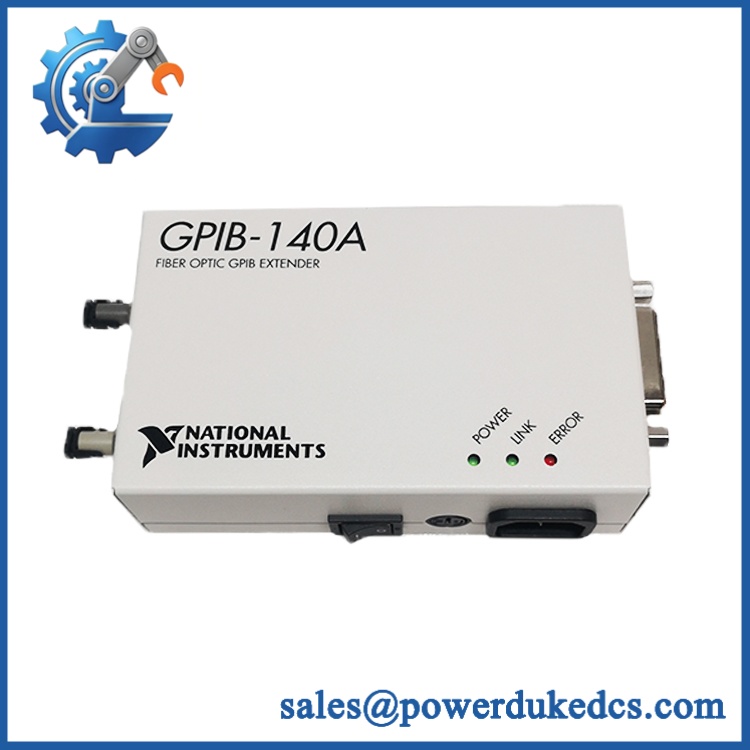
NI GPIB-140A
The published environmental data are particularly useful for warehouse controls: storage is specified from −20 to +70 °C, with 10–90% RH noncondensing.
? Global Compliance & Industry Certifications
NI’s certification records identify multiple assemblies, including 186135-01L, 186135-02L, 186135-31L, and 186135-32L, with applicable EU/UK declarations, KC EMC documentation, and UL product-safety information depending on the exact assembly.
Expected compliance documentation may include:
- CE / EU Declaration of Conformity: Applicable to listed variants.
- UK Declaration of Conformity: Listed for applicable assemblies.
- UL product safety: Listed for several assemblies.
- KC EMC: Listed for applicable variants.
- EMC: The legacy manual identifies EN 61326, EN 55011, FCC Part 15B, and ICES-001 Class A requirements.
- ATEX / IECEx: No basis to claim hazardous-area certification for this model; verify the exact product documentation before any hazardous-location application.
- Marine approvals: Do not claim DNV or equivalent marine approval unless the specific assembly has documented classification approval.
The Class A EMC designation matters in industrial installations because the equipment is intended for controlled commercial/industrial environments and requires appropriate cabling practices. NI specifically states that shielded GPIB cabling is required for EMC compliance.
Verify specific lot certifications with OEM.
? Long-Term Storage & Asset Preservation Guide
- Protect the optical ports. Keep the ST connectors capped and protected from dust. Contamination on fiber end faces can cause insertion loss or intermittent communication after years of storage.
- Retain the metal enclosure in dry, controlled storage. The specified storage range is −20 to +70 °C with noncondensing humidity; avoid repeated temperature excursions that can produce internal condensation.
- Preserve the original packaging and identification labels. Because this is a discontinued product, the serial number, assembly part number, and certification label have significant asset-control value. Do not remove labels during cleaning or refurbishment.
Before returning a long-stored unit to service, inspect the GPIB connector, optical ST interfaces, power-input hardware, enclosure, and internal signs of corrosion. Clean fiber interfaces using an approved optical cleaning procedure—not ordinary shop wipes.
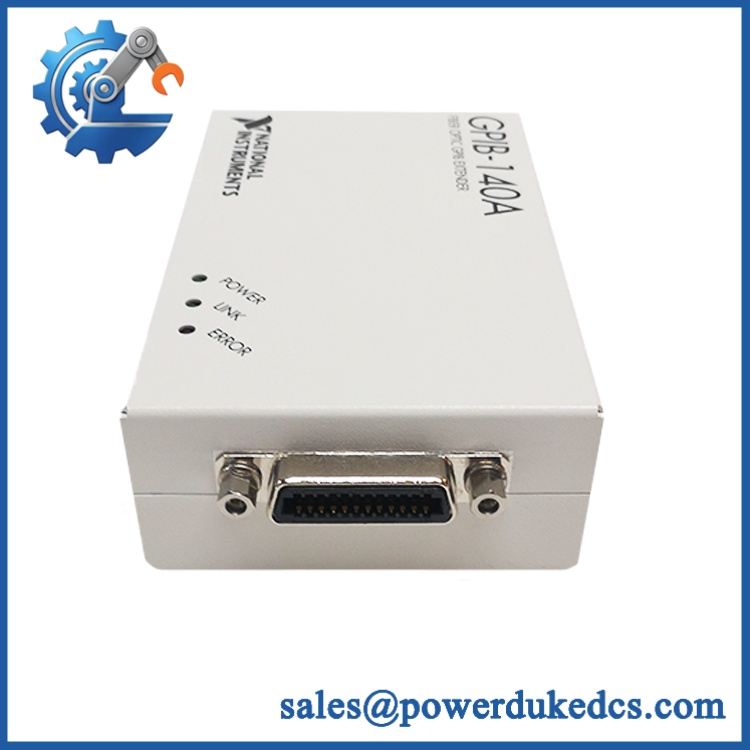
NI GPIB-140A
Physical Installation Prerequisites
- Install the on a stable cabinet, bench, or equipment-rack surface where the metal enclosure cannot contact exposed energized conductors.
- Maintain sufficient free space around the enclosure for heat dissipation and connector access; the published documentation does not establish a universal 50 mm top/bottom clearance, so use the actual installation arrangement rather than inventing a clearance value.
- Use the specified shielded GPIB cable for EMC compliance.
- Route the optical cable with its manufacturer’s minimum bend radius and protect ST connectors from mechanical loading.
- Confirm protective grounding and power-supply requirements before energization.
- Do not substitute merely because the housing looks similar. The /2 variant is a different 2 km extender, and NI documents compatibility distinctions between the legacy family members.
Buyer’s FAQ
Q: What HS Tariff Code should be used for the ?
A: Classification should be based on its actual function as a GPIB bus-extending interface rather than treating it as a passive cable. The final HS code can vary by jurisdiction, so confirm the classification against the technical description and destination-country tariff schedule before preparing the commercial invoice.
Q: Does the COO follow the NI brand?
A: No. Country of Origin must reflect the actual manufacturing origin supported by the unit’s documentation or supplier declaration. The NI brand, seller location, and shipping origin are not sufficient evidence of COO.
Q: Should I insure a 0.25 kg unit during international shipment?
A: Consider the replacement value and system criticality, not just physical weight. This is a discontinued interface, so a low-weight shipment can still represent significant operational exposure if the spare is difficult to replace. Record the serial number and photograph the optical connectors and enclosure before dispatch.
Q: Does the contain the latest firmware?
A: Do not treat it like a modern field-programmable controller. The critical compatibility attributes are the exact variant, hardware/assembly part number, optical configuration, and installed system architecture. NI identifies the product as discontinued and recommends the GPIB-140B as its replacement, but replacement should be validated against the existing system before changing a qualified installation.



 Start Chat