
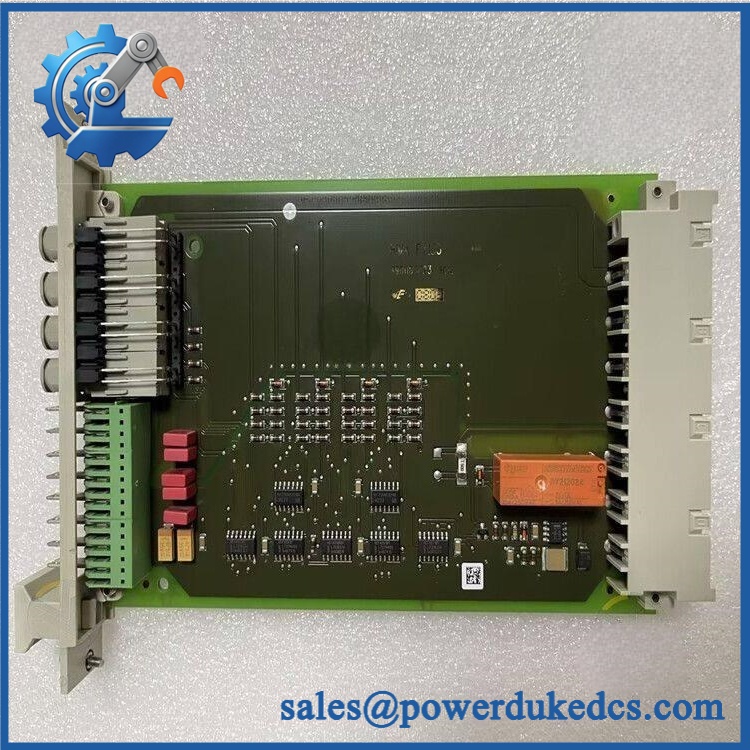

Description
- Brand: HIMA
- Full Model Number: F6705
- System/Series Family: H41q / H51q / HIQuad
- One-Sentence Core Function: Two-channel safety-related D/A output module for controlled 0/4–20 mA actuator signals
- Top 3 Hardcore Specs: 2 analog output channels; 12-bit resolution; 0/4–20 mA current output with source or sink operation
- Stock Status: Stock condition and hardware revision to be confirmed
Module 3: Technical Product Introduction
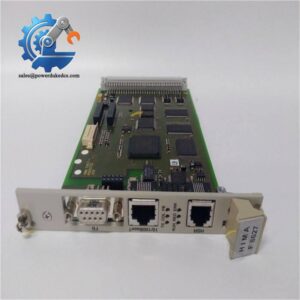
A failed analog output channel can leave a valve, actuator, or other final control element without a valid command even though the central processor and I/O bus remain healthy. HIMA F6705 is a two-channel safety-related analog output module used in H41q/H51q systems. It provides galvanically isolated current outputs, supports source and sink operating modes, and incorporates a safety shutdown function. During operation, the module continuously checks output feedback, D/A-converter linearity, cross-talk, and the integrated shutdown circuit.
Resolution is 12 bits, with the published characteristic using 4095 conversion steps; the module supports 0/4–20 mA operation and can be used with line lengths up to approximately 1,000 m subject to the connected burden. At 25 °C, the specified basic error is ≤0.2%, while the operating error is ≤0.4% over 0 to +60 °C. Electrical strength is specified at 250 V against Analog-GND. These figures make the F6705 suitable for applications where the output signal itself is part of the safety function, not merely a standard process-control indication.
Module 4: Application Scenarios & Field Realities
- In a refinery shutdown or process-control loop, the F6705 can drive a current-operated final element where the analog command has safety significance. The important commissioning check is not just whether 4–20 mA appears at the terminal; the receiving actuator, output mode, burden, and fault response must all agree with the approved design.
- Where two channels are used for a safety-related actuator arrangement, pay attention to the current-source versus current-sink configuration. HIMA documentation states that redundant parallel connections require both channels to use the same operating mode, with the allowable burden and channel current adjusted accordingly.
- For long field cables, the published maximum line length is 1,000 m, but the allowable burden still matters. A loop can pass a basic continuity check and fail to deliver the required current at the field device if cable resistance and load resistance are not included in the calculation.
- During fault investigation, F6705’s internal diagnostics are useful before replacing the module outright. The safety manual identifies output readback, D/A linearity, cross-talk, and safety-shutdown testing as automatic checks. In current-source mode, detected faults drive the affected module into a safe de-energized state.
Module 5: Migration, Compatibility & Installation Traps
Replacement Matrix
Replacement Classification: Drop-in Replacement Within the Matching H41q/H51q Configuration
For an existing HIMA installation designed for F6705, a replacement is generally a direct hardware exchange when the system architecture, module revision, terminal arrangement, and application configuration match. The is specifically documented as a safety-related analog output module for H41q/H51q systems. No software recompilation should normally be required for a like-for-like replacement, although the approved project configuration and safety documentation must still be checked before return to service.
⚠️ Field Traps — Watch Out
1. Source/sink mode mismatch: The wiring and fault-response behavior differ between current-source and current-sink operation. In source mode, an internal fault or detected external open circuit causes the module to enter the safe de-energized state. In sink mode, external shutdown of the loop supply is required; HIMA specifies use of the HZ-FAN-3 function block for fault evaluation.
2. Redundant-channel loading: When two channels are connected in parallel, both channels must operate in the same mode. The total current is the sum of the individual channel currents, while the permissible burden resistance is reduced accordingly. Check the actuator’s tolerance for transient current changes before commissioning the redundant arrangement.
Module 6: Quality Assurance SOP
Each HIMA should pass a documented inspection and functional test before shipment.
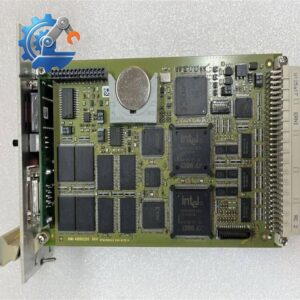
- OEM identification visual inspection: Verify HIMA markings, designation, serial or identification labels, connector condition, PCB assembly, terminal markings, and hardware revision.
- Mechanical inspection: Check the housing, mounting points, terminal interface, front-panel condition, connector pins, and evidence of impact, corrosion, contamination, or prior repair.
- Configuration verification: Record the installed project designation where available and document whether the customer’s application uses current-source or current-sink operation.
- Power verification: Apply the specified rack supply using an approved HIMA-compatible test arrangement and verify stable module startup.
- Power-on self-test (POST): Confirm normal module initialization and inspect diagnostic indications before functional testing.
- Analog output test: Test both channels across representative current points, including zero/low-scale, mid-scale, and high-scale values, using calibrated measurement equipment.
- Output readback verification: Confirm the module’s output-monitoring behavior and compare measured current with the expected commanded value.
- D/A linearity check: Verify that the output tracks the applied digital command within the applicable test tolerance. HIMA identifies D/A-converter linearity as an automatic operating test.
- Cross-talk verification: Drive one channel while monitoring the other to confirm that channel interaction remains within the approved test limits.
- Safety shutdown verification: Test the integrated safety-shutdown response using the authorized procedure. HIMA documentation identifies this as a dedicated self-test function.
- Final QC record: Retain serial number, revision, measured output values, source/sink configuration, test-equipment identification, diagnostic observations, and final QC approval.
For a safety-related analog output module, appearance is only the first inspection gate. The ‘s value is in its controlled analog output and its internal diagnostic and shutdown behavior; those functions should be verified before a warehouse spare is released for a live H41q/H51q application.


 Start Chat